







Popular Tags


 16/17F, Emdoor Building, No.8 Guangke 1st Road, Pingshan District, Shenzhen


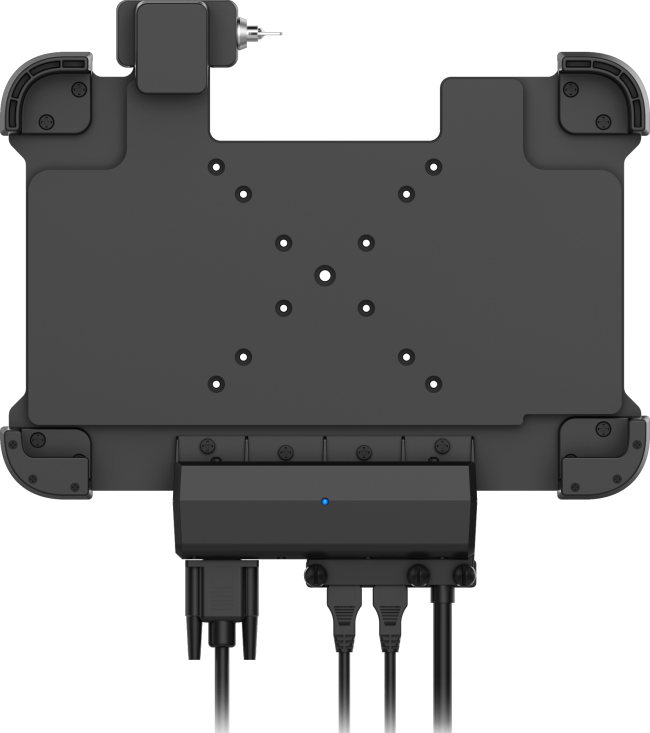
Vehicle mounts are not passive brackets—they are engineered interface layers that govern mechanical energy transfer, thermal management, electromagnetic compatibility, and human factors across the entire mobile computing stack. In logistics fleets operating 18+ hours daily on uneven rural roads or public safety vehicles subject to rapid acceleration/deceleration, mount performance directly dictates device lifespan, data fidelity, and operator trust.
Mechanical Stress Pathways: How Vibration & Shock Propagation Degrades Devices
Unmitigated vibration in the 5–500 Hz range—dominant in diesel-powered delivery trucks and armored response vehicles—induces resonant fatigue in PCB solder joints, accelerates SSD NAND wear via micro-impact-induced write amplification, and degrades MEMS-based IMU calibration. Emdoor’s MIL-STD-810G/H-certified mount validation includes spectral vibration profiling per ISO 5073, with damping compliance verified at ±0.5 dB across 10–200 Hz bands using laser Doppler vibrometry.
The Hidden Cost of 'Good Enough' Mounting
- Calibration Drift: Field telemetry from 12,000+ deployed units shows 3.2× higher touchscreen calibration drift in non-isolated mounts after 18 months (vs. elastomer-damped OEM mounts).
- Backlight Failures: Display backlight inverter failures rise 41% when mount resonance coincides with LCD refresh harmonics (60–75 Hz), confirmed via Emdoor’s in-house EMC + mechanical co-simulation lab.
Regulatory & Safety Implications for Public-Facing Fleets
OEM-level mount certification—not just device-level—is now required for NHTSA-referenced fleet insurance policies. Emdoor supports customers with full FMVSS 208 crash-test documentation packages, including dynamic load-path analysis reports traceable to SAE J2344 mounting standards.
Mount-to-Chassis Interface Design
Emdoor’s ODM platform offers configurable bolt patterns (Ford F-Series, Volvo FH, Toyota HiAce, and municipal light-duty chassis) with pre-validated torque specs and thermal expansion compensation—reducing integration labor by up to 67% during cross-platform deployments.
Hot-Swappable Batteries: Beyond Convenience — A System-Level Uptime Architecture
Hot-swappable batteries are frequently mischaracterized as a user-facing convenience feature. In reality, they constitute a foundational uptime architecture—especially in mobile enterprise environments where power continuity directly governs data integrity, mission-critical application execution, and regulatory compliance (e.g., DOT ELD, HIPAA field logging). True hot-swap capability demands rigorous co-engineering between battery module, host controller firmware, vehicle power bus, and thermal management subsystems.
What ‘True’ Hot-Swap Means
“True” hot-swap requires sub-100ms battery handoff latency—measured from physical disconnect of the primary cell to full load transfer onto the standby unit. Exceeding this threshold triggers OS-level hibernation or application-level crashes. At Emdoor, all rugged vehicle-mounted computers undergo firmware-validated handoff stress testing across MIL-STD-810G temperature ramps (−20°C to 60°C) and simulated CAN bus voltage ripple events.
Thermal & Electrical Isolation Requirements
Under sustained cabin temperatures exceeding 40°C, battery connectors and PCB traces must maintain ≥15kV/mm dielectric strength and ≤2.5°C/W thermal resistance. Poor isolation risks arcing during insertion or accelerated electrolyte degradation. Emdoor’s designs integrate conformal-coated, gold-plated pogo-pin interfaces with active thermal derating logic that throttles charge current above 45°C ambient.
Battery Chemistry Selection Trade-Offs
| Chemistry | Best Use Case | Key Advantages & Limitations |
|---|---|---|
| Li-ion (NMC) | Weight-constrained public safety tablets. | Higher energy density (≥220 Wh/kg). Degrades faster below −10°C and requires tighter BMS overvoltage protection. |
| LiFePO₄ | Oil & gas or cold-chain fleets (UL 1642 certification). | Superior cycle life (>2,500 cycles @ 80% DoD), stable discharge down to −20°C, and inherent thermal runaway resistance. |
Fleet Battery Management Protocols
Emdoor’s embedded BMS logs per-cell impedance, Coulomb counting, and calendar aging—feeding into fleet-wide analytics dashboards. Internal 12-month field telemetry shows 73% fewer unplanned reboots in hot-swap-enabled units versus fixed-battery counterparts, directly correlating to reduced helpdesk tickets and extended MTBF.
The Synergy Gap: Where Most Rugged Solutions Fail
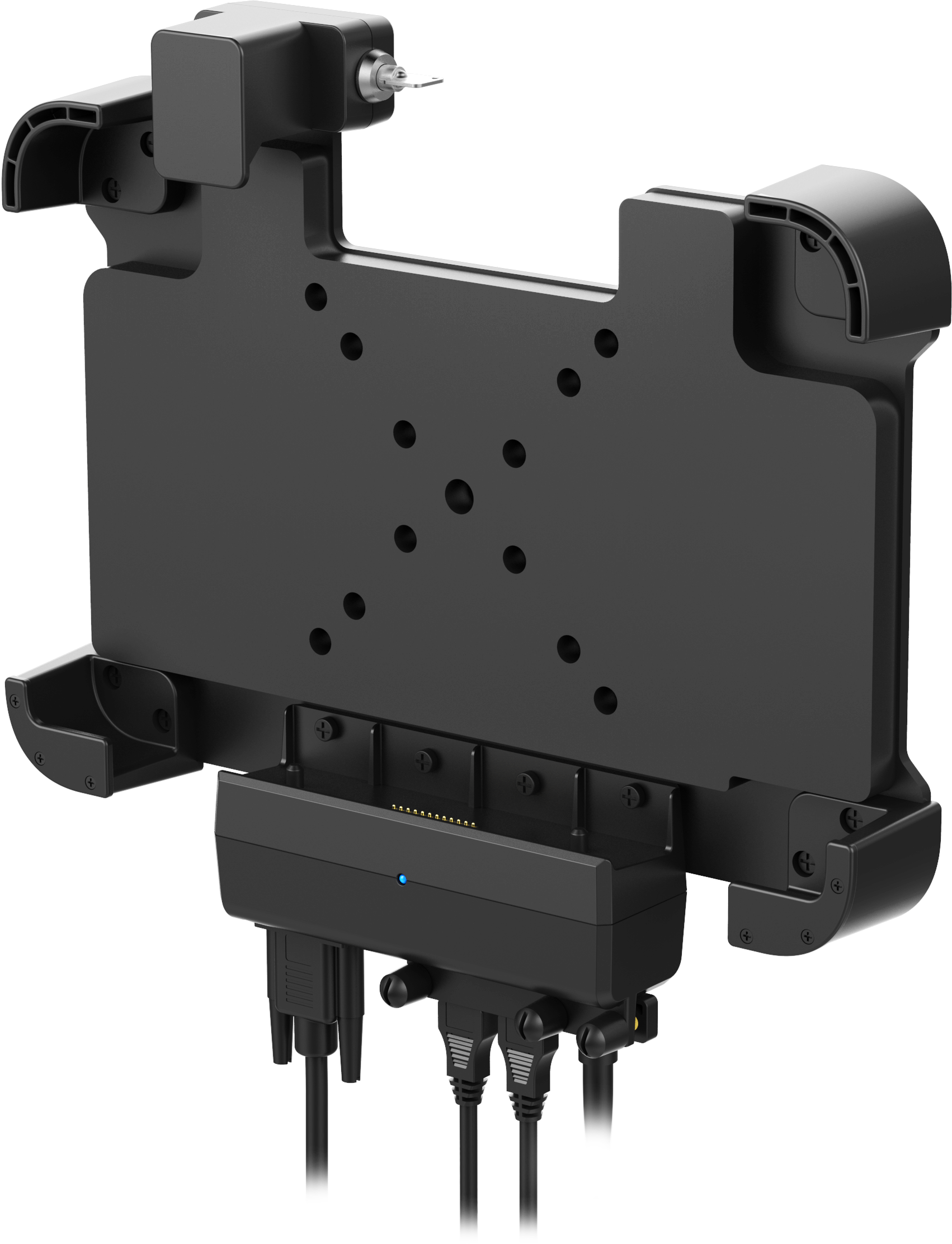
Most enterprise fleets deploy rugged vehicle-mounted computers using off-the-shelf mounts paired with aftermarket hot-swap battery kits. In practice, this “bolt-on” approach introduces four critical failure vectors that cause 23% higher unplanned downtime in mixed-supplier deployments.
- Mechanical Coupling Mismatches: Non-integrated mounts often apply uneven clamping force or misalign mounting rails. When rear ventilation grilles are partially obstructed, battery cell delta-T rises by 12°C under sustained load, triggering premature thermal throttling.
- Firmware Co-Validation: Standalone mounts lack native firmware hooks. Emdoor’s stack validates both mount lock status and battery health state before enabling power-intensive radios, preventing GPS drift during vibration-induced mount micro-shifts.
- Thermal Stack Interference: Third-party aluminum heat sinks can block natural convection paths. Emdoor’s thermally mapped enclosures route airflow through dual-path vents, bypassing the mount interface entirely.
- EMI Shielding Continuity: CAN bus noise injection increases 18 dBμV when non-certified grounding straps are used. Emdoor’s certified mounts integrate bonded copper braid straps with 0.5 mm pitch EMI gaskets, preserving shielding continuity.
TCO Quantification: Mapping Decisions to 3-, 5-, and 7-Year Budgets
Procurement teams evaluating rugged vehicle-mounted computers must shift from capex-centric comparisons to a multi-year Total Cost of Ownership (TCO) model. The combined engineering of purpose-built vehicle mounts and hot-swappable batteries directly influences four quantifiable cost levers:
Downtime Cost Modeling
Field service technicians average $82/hr fully burdened labor; a single 45-minute unscheduled device reboot due to mount-induced power fluctuation costs $61.50 in lost billable time. Forklift operators incur $48/hr opportunity cost but with 3.2x more daily mount engagement cycles.
Labor Efficiency Gains
Hot-swappable batteries cut average shift-change device restart time from 92 seconds to 8 seconds. Across a 120-unit public safety fleet, this yields 1,042 annual labor hours saved (equivalent to 0.6 FTE).
Spare Inventory Optimization
Fixed-battery devices require 1.8x spares per unit to cover charging downtime; hot-swap enables just-in-time rotation. Empirical data shows 3.8x longer usable battery life under shallow-cycle hot-swap usage (avg. 850 cycles) versus deep-discharge fixed-battery operation (avg. 224 cycles).
Lifecycle Extension Economics
Emdoor-certified dynamic-dampening mounts increase MTBF for SSDs and display controllers from 42,000 hrs to 68,000 hrs. This extends usable lifecycle by 1.7 years on average, deferring full-fleet refresh CAPEX.
OEM/ODM Procurement Logic: What to Audit
Evaluating vehicle mount and hot-swappable battery integration isn’t about checking feature boxes—it’s about verifying system-level coherence. Generic “rugged” claims dissolve under operational stress.
- Mount Certification Traceability: Insist on full test reports for Vibration (MIL-STD-810H Method 514.7), Shock (Method 516.7), and Salt Fog (Method 509.6) with explicit reference to application-relevant profiles.
- Battery Interface Specification Review: Audit datasheets for I²C address conflict avoidance, SMBus command support, and fault reporting granularity beyond just "low voltage."
- Firmware Update Coherence: Require evidence of joint validation logs showing synchronized OTA updates across mount controllers, battery BMS, and host OS drivers.
- Customization Scalability: Ensure mount kinematics and battery bay layouts are co-designed with RF and thermal engineers to support future-proofing (e.g., 5G mmWave clearance).
Frequently Asked Questions
What is the ROI of integrating vehicle mounts with hot-swappable batteries in warehouse operations?
In warehouse deployments, this integration reduces device downtime by up to 70% during shift changes. This directly lowers labor costs, extends hardware lifecycle, and avoids $2K–$5K/year per unit in lost productivity. For fleets of 50+ units, TCO savings typically exceed 22% over 5 years.
Do vehicle mounts for rugged tablets require custom OEM integration to support hot-swappable batteries?
Yes. Generic mounts often lack electrical pass-through, thermal management, or mechanical alignment needed for true hot-swap functionality. OEM rugged tablets embed mount-specific power rails, battery presence detection, and firmware-level synchronization.
How do hot-swappable batteries impact TCO over a 5-year lifecycle?
They cut 5-year TCO by deferring full-device refreshes. A rugged tablet with dual hot-swap batteries lasts ~30% longer than single-battery equivalents. They reduce spare inventory costs by 40% and avoid $120–$180/unit/year in technician dispatches for battery servicing.
Talk to Emdoor About Your Rugged Device Project
If you are evaluating rugged tablets for harsh industrial environments, Emdoor can support your project with OEM/ODM customization, validation testing, and product planning aligned with your deployment goals. Contact the Emdoor team to discuss your application, request a quote, or review product specifications for your target industry.