







Popular Tags
 16/17F, Emdoor Building, No.8 Guangke 1st Road, Pingshan District, Shenzhen

 16/17F, Emdoor Building, No.8 Guangke 1st Road, Pingshan District, Shenzhen


The Hidden Failure Point: How Standard I/O Ports Undermine Operational Continuity in Harsh Environments
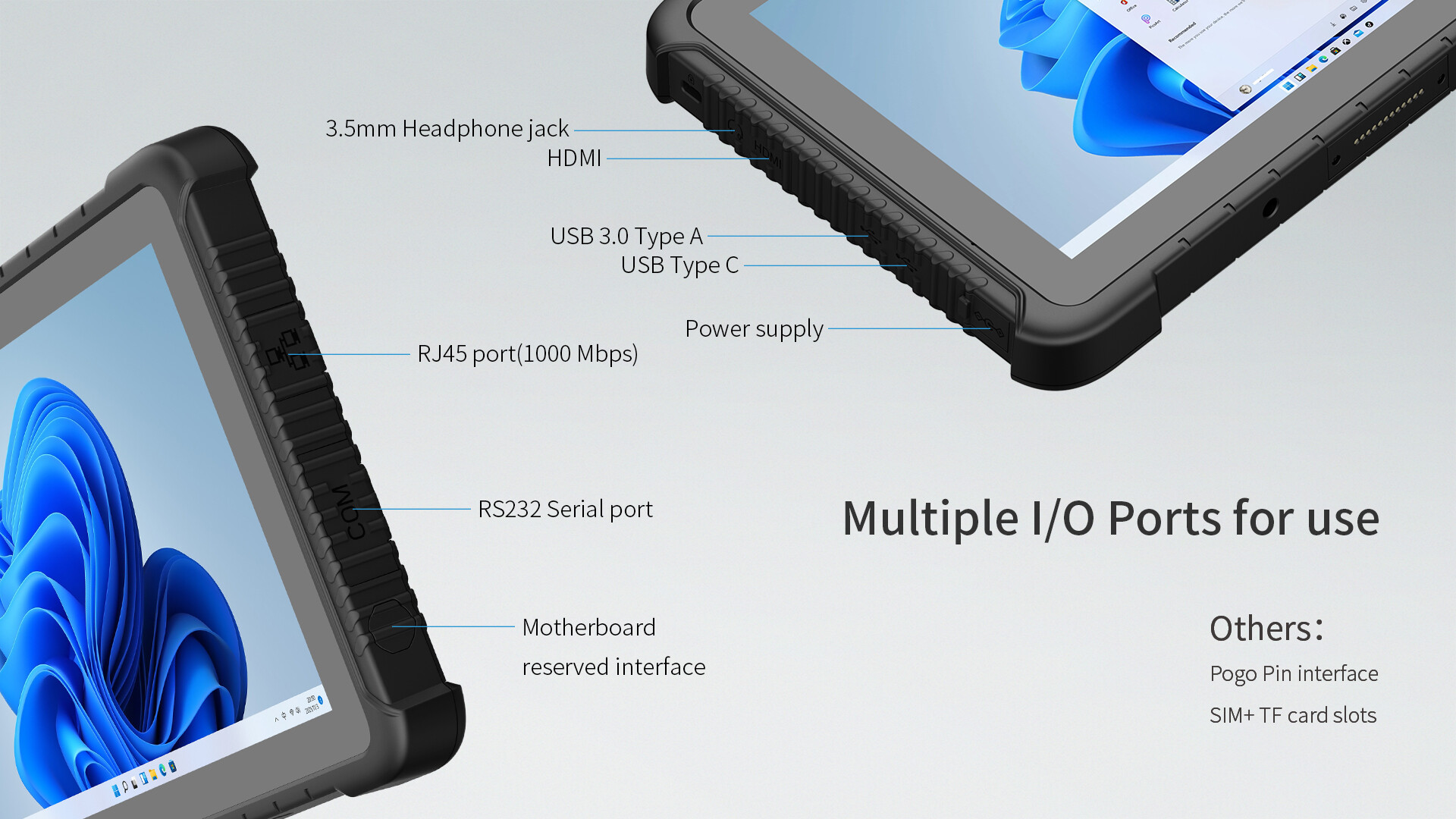
Standard I/O ports—designed for office-grade reliability—are a silent liability in enterprise rugged deployments. When subjected to extreme thermal cycling, EMI-heavy machinery zones, or continuous vibration, generic USB-C hubs, consumer-grade RS-232 dongles, or unshielded serial headers fail not with fanfare, but with insidious signal degradation and intermittent disconnects—triggering cascading operational failures.
Field Service Breakdowns Due to Incompatible Interfaces
In utility metering, field tablets routinely interface with legacy Modbus RTU sensors requiring isolated RS-485. Off-the-shelf tablets lack integrated termination networks; at -20°C, impedance mismatch causes bit errors (>12% CRC failure rate observed in Nordic grid audits). Retrofitting external isolators adds 37mm height, compromising IP67 seal integrity.
Warehouse Automation Failures from Non-Standard Trigger Signals
Automated sortation demands precise, hardware-synchronized trigger pulses (<5µs jitter). Consumer USB-to-serial adapters introduce software-mediated latency (up to 18ms). At a Tier-1 e-commerce fulfillment center, this caused 2.4% misreads per shift—translating to $192K annual labor rework cost per site.
Public Safety & Oil & Gas Connective Fatigue
Vehicular RF noise induces >3Vpp common-mode noise on non-filtered DB9 ports, disrupting CAD data sync. Furthermore, standard connectors suffer solder-joint fatigue after 500+ hours at 85°C and 10–2000 Hz random vibration. Emdoor’s custom I/O solutions embed gold-plated, 50µ" thick contact plating—validated across 2,000 thermal cycles (-40°C to +75°C).
Beyond Pinouts: The Engineering Dimensions of True Custom I/O Design
Custom I/O ports are not merely rerouted traces on a PCB—they represent a systems-level engineering commitment spanning signal physics, mechanical durability, electrical safety, and firmware intelligence.
- Signal Integrity & EMC: A true custom design enforces controlled impedance, integrates multi-stage TVS diodes rated to ±15 kV contact ESD, and meets MIL-STD-461F RS103 and CS114 thresholds.
- Mechanical Integration: From M12 X-coded Ethernet for washdown zones to LEMO FGG.0B series for medical carts, all undergo 500+ hours of combined shock (50 g, 11 ms) and random vibration per MIL-STD-810H Method 516.8.
- Electrical Isolation: Emdoor’s isolation architecture uses reinforced 2.5 kV RMS optocouplers and split-ground planes to prevent sensor drift during alternator load dumps in vehicle-mounted systems.
- Firmware Flexibility: Xilinx Spartan-7 FPGAs enable post-deployment reassignment of pins and deterministic <50 µs latency for closed-loop PLC interfacing.
Procurement Logic Reimagined: Custom I/O as a Lifecycle Investment
Cost Analysis: $28K Custom Engineering vs. $42K Post-Deployment Labor
Field-deployed adapters require mounting hardware, enclosure modifications, and validation. Emdoor’s pre-integrated I/O controllers—tested alongside full-system thermal and EMC profiles—avoid $42K+ in post-build labor across a 500-unit rollout.
Certification & Component Longevity
Every external converter breaks the sealed ingress path, voiding IP67 and MIL-STD-810H compliance. Emdoor validates custom interfaces as part of the full device. Furthermore, we select I/O ASICs qualified for 10+ year industrial availability, fully traceable per ISO/TS 16949.
The OEM/ODM Advantage: Deep Hardware-Software Co-Design
Unlike contract-manufactured “bolt-on” interfaces, true custom I/O demands co-design across hardware layout, firmware logic, kernel drivers, and secure boot policy.
- Co-Verification: Validates signal propagation and interrupt routing against PREEMPT_RT Linux kernels and FreeRTOS for sub-100 µs deterministic latency.
- Driver Certification: Active WHQL and Red Hat ISV partnerships deliver zero-day OS compatibility for Windows IoT and RHEL.
- Secure Boot Extension: Extends UEFI Secure Boot to cover custom I/O microcontroller firmware, preventing DMA hijacking in field-deployed devices.
Supply Chain Resilience: Component Strategy Shapes Port Reliability
Dual-sourcing isn’t about part number parity; it’s about revalidating insertion loss and common-mode rejection across temperature and vibration. Emdoor ensures long-term obsolescence management via joint last-time-buy planning and rigorous lot-level ESD testing (8kV contact/15kV air) for critical components to meet DFARS and EU Cyber Resilience Act mandates.
Vertical-Specific I/O Architectures
- Mining Fleet Management: Opto-isolated CAN FD ports compliant with SAE J1939-15 and precision 4–20 mA analog inputs.
- Smart Utility Substations: Hardened fiber-optic SFP+ cages with integrated IEEE 1588v2 hardware timestamping.
- Cold-Chain Logistics: Simultaneous 1-Wire and DS18B20 protocols with calibrated input linearity, factory-trimmed against NIST-certified reference baths.
- Defense Mobile Command: AES-256 tunneling of RS-232/422 streams via hermetically sealed MIL-DTL-38999 Series III connectors.
Frequently Asked Questions
Why do enterprise warehouse deployments require custom I/O ports?
Standard ports fail in dynamic environments due to vibration and dust. Custom I/O (e.g., sealed M12 connectors, GPIO for CAN bus integration) ensures mechanical robustness, ESD immunity, and WMS hardware compatibility without compromising IP65/IP67 integrity.
Can custom I/O ports be added to off-the-shelf tablets post-manufacture?
No—true custom I/O requires PCB-level redesign and enclosure re-certification. Retrofitting introduces reliability risks like compromised sealing and EMI leakage. Enterprise-grade deployments demand factory-integrated I/O for 5–7-year lifecycle stability.
How does custom I/O design impact supply chain resilience?
Proprietary connectors can create single-source dependencies. Emdoor mitigates this by co-designing with dual-sourced, industrial-grade components and maintaining ≥18-month buffer stock, ensuring uninterrupted production globally.
Talk to Emdoor About Your Rugged Device Project
If you are evaluating rugged tablets for harsh industrial environments, Emdoor can support your project with OEM/ODM customization, validation testing, and product planning aligned with your deployment goals. Contact the Emdoor team to discuss your application, request a quote, or review product specifications.