




Related News


 16/17F, Emdoor Building, No.8 Guangke 1st Road, Pingshan District, Shenzhen


AI is becoming part of everyday work and life.
At first, most users interact with AI in a simple way: writing a few sentences, polishing emails, explaining technical terms, or organizing scattered notes.
These tasks are light, low-risk, and easy to handle. They usually involve little private information. For users, the main expectations are simple: accurate answers, fast response, and usable results.
But AI usage is changing.
As people begin to use AI for more important, valuable, and private tasks, the relationship between users and AI becomes more complex. Meeting notes, internal company documents, customer information, confidential project plans, personal knowledge bases, family files, and long-term private data may all become part of the AI workflow.
At that point, users naturally begin to ask harder questions.
Is it safe to upload private information?
Could connected AI tools expose sensitive data?
Should internal files be processed in a public cloud environment?
Can long-term use of cloud AI remain affordable?
These concerns are not excessive. They are real.
For many users, the two core questions are clear: Can privacy be protected? Can cost remain manageable?
To answer these questions, Emdoor Group introduces Ailyn, an AI intelligence hub designed to make AI safer, smarter, and more cost-effective.
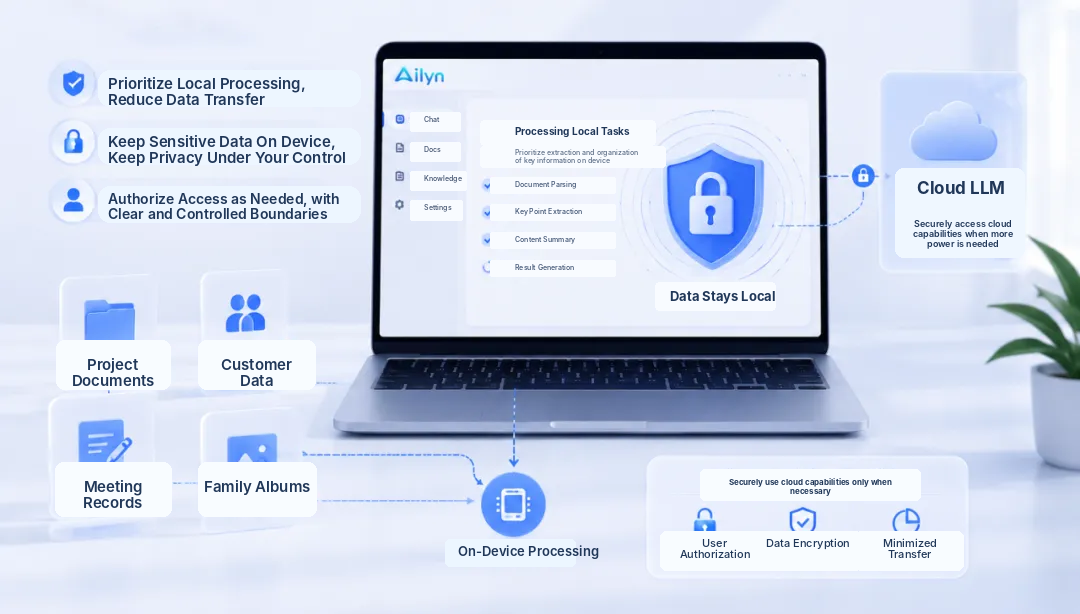
Ailyn follows a clear principle: keep private data closer to the user whenever possible, and use cloud computing only when the task truly requires it.
Edge First: Privacy Under User Control
Ailyn is built around an edge-first approach.
That does not mean every task must be processed locally. Cloud-based large language models still have strong advantages in complex reasoning, high-quality content generation, real-time online search, and multi-step analysis.
But not every task should automatically go to the cloud.
Ailyn takes a more balanced approach. Tasks that can be completed locally are handled by edge-side AI models first. Tasks involving private or sensitive data are kept within a more controlled environment whenever possible. Only when advanced computing power is required will Ailyn call cloud AI capabilities, and that process should happen with clear user authorization and security boundaries.
In short, Ailyn adds one important decision before each AI task begins:
Does this task need to send private data to the cloud?
This question matters.
Many daily AI tasks do not require heavy cloud computing. For example, a user may need to summarize an internal meeting note stored locally. That document may include project schedules, team responsibilities, customer feedback, or business information that has not been publicly released.
In this case, Ailyn can first evaluate the task type and use a local AI model to extract key points, classify information, and break down action items. If the user later wants to ask deeper questions based on a local knowledge base, the system can access the relevant files within a controlled authorization range instead of uploading everything by default.
Only when the user needs complex reasoning, long-form content creation, online research, or advanced analysis does Ailyn call cloud AI resources, supported by user authorization and data security measures.
This dual-track model gives users stronger control.
When privacy is the top priority, users can rely more on local AI processing. When higher performance is needed, they can use cloud AI under controlled conditions.
Ailyn’s goal is simple: let AI understand user data, but never cross user boundaries without permission.
AI should help users.
It should also protect them.
Edge-Cloud Collaboration: Better Cost Efficiency
As AI becomes a high-frequency tool, cost becomes another key issue.
Cost does not only mean the platform bill. For heavy AI users, cost appears across the whole workflow: waiting time, repeated file uploads, continuous cloud token usage, wasted local hardware resources, and the unnecessary use of large models for simple tasks.
A simple task should not always consume heavy cloud computing power.
For users who only ask occasional questions, these hidden costs may not feel obvious. But for professional users who rely on AI every day, these costs add up quickly.
Ailyn addresses this with edge-cloud collaboration.
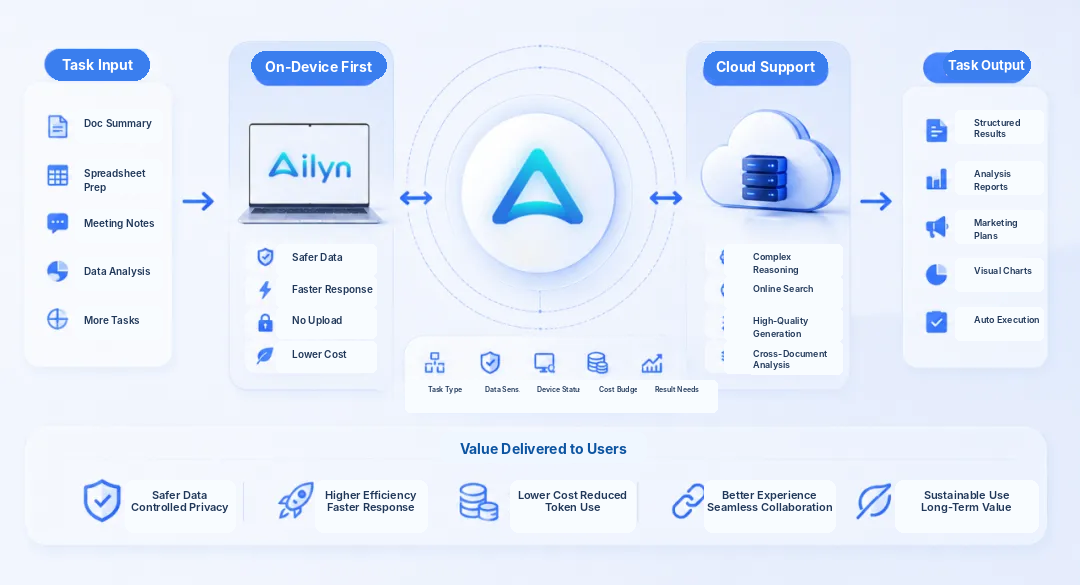
The idea is not to force every task into one processing path. Instead, Ailyn helps match each task with the most suitable computing resource. Local models, cloud models, device resources, and task rules can work together so that computing power is used where it creates the most value.
For example, a user has just attended an industry exhibition and needs to organize a visit report.
For the first task, Ailyn may call a cloud model to complete the full workflow design: define information selection rules, extract key points, build the report structure, and create a standard execution path.
When the user later handles similar exhibition reports or industry research notes, the system no longer needs to rely on cloud AI from the beginning each time. It can reuse the previous workflow. The local side can complete lighter tasks such as file filtering, basic formatting, and initial summarization. Cloud AI is then used only when deeper analysis, marketing strategy writing, or advanced copy refinement is needed.
The cloud model works where it matters most.
This improves efficiency and reduces unnecessary cost.
Edge-side AI and cloud-side AI each have clear strengths. Edge devices are closer to the user’s original data. They offer shorter data transmission paths, faster response for lightweight tasks, and stronger privacy control. They are well suited for repeated tasks, rule-based workflows, sensitive data, and local document processing.
Cloud AI provides stronger reasoning capability, larger knowledge coverage, and online access. It is better suited for complex logic, cross-document analysis, high-quality original content creation, and tasks that exceed local computing capacity.
Ailyn does not reject the cloud.
It also does not depend on it for everything.
Instead, Ailyn builds a smarter division of work.
Computing Power With Clear Division Of Labor
The value of AI does not come from using the largest model for every task. It comes from using the right capability at the right time.
This is where Ailyn’s core design becomes important.
Simple tasks should be lighter.
Sensitive tasks should be safer.
Complex tasks should have cloud support.
High-frequency tasks should not carry unnecessary long-term cost.
With Ailyn, local AI can take care of many repeated and private workflows. Cloud AI can support high-level reasoning and advanced content tasks. When users connect private computing devices in the future, local computing capacity can also expand, allowing more medium-to-complex tasks to run closer to the user.
This creates a more flexible AI experience.
Users do not need to choose between privacy and capability in a rigid way. They can decide how data is processed, when cloud AI is used, and how computing resources are allocated.
Ailyn brings AI closer to real usage scenarios.
A Safer And More Cost-Effective AI Experience
Edge-first processing protects the user’s control over data. Edge-cloud collaboration improves the way AI capability is used.
Together, these two principles form Ailyn’s product logic:
AI tasks should not have only one execution path.
AI should not send every task to the cloud by default.
Ailyn is not designed as a single technical route. It is designed as a practical choice for real users.
For private content, it helps reduce unnecessary data exposure.
For repeated tasks, it helps reduce cloud computing waste.
For complex tasks, it keeps cloud AI available.
For long-term AI use, it helps make the cost structure more reasonable.
Emdoor Group has always followed the mission of making advanced technology more accessible. In the AI era, that mission continues through Ailyn.
Ailyn keeps data closer to users and puts computing power where it is needed most.
It helps users use AI with more confidence, more control, and better value.