



AI is becoming part of everyday work and life. For many users, it is no longer just a temporary question-answering tool. It is now used to write weekly reports, organize documents, translate content, summarize information, process workflows, and support decision-making.
But real-world usage is rarely as smooth as a demo.
Network access can be unstable, yet tasks cannot simply stop. Similar requests appear repeatedly, yet users often need to explain the same requirements again and again. AI can complete a single task, but it often fails to remember a user’s preferred format, tone, workflow, and working habits over time.
As a result, repeated explanation, repeated adjustment, and missing context can become a new kind of productivity cost.
To address these real-world challenges, Emdoor Group introduces Ailyn, an AI Intelligent Hub designed to deliver a more stable, personalized, and long-term AI experience.
Ailyn focuses on two core capabilities: first, it helps maintain basic AI availability across different network environments, so tasks are less likely to be interrupted by connectivity limitations. Second, it continuously learns from repeated use, preserving proven workflows and user preferences so the AI becomes more helpful over time.
01 Offline Availability: Keep Tasks Moving
Stable AI Support in Real-World Environments
One of the most easily overlooked limitations of AI is its dependence on network access. Once the user leaves an ideal network environment, AI capability can drop sharply.
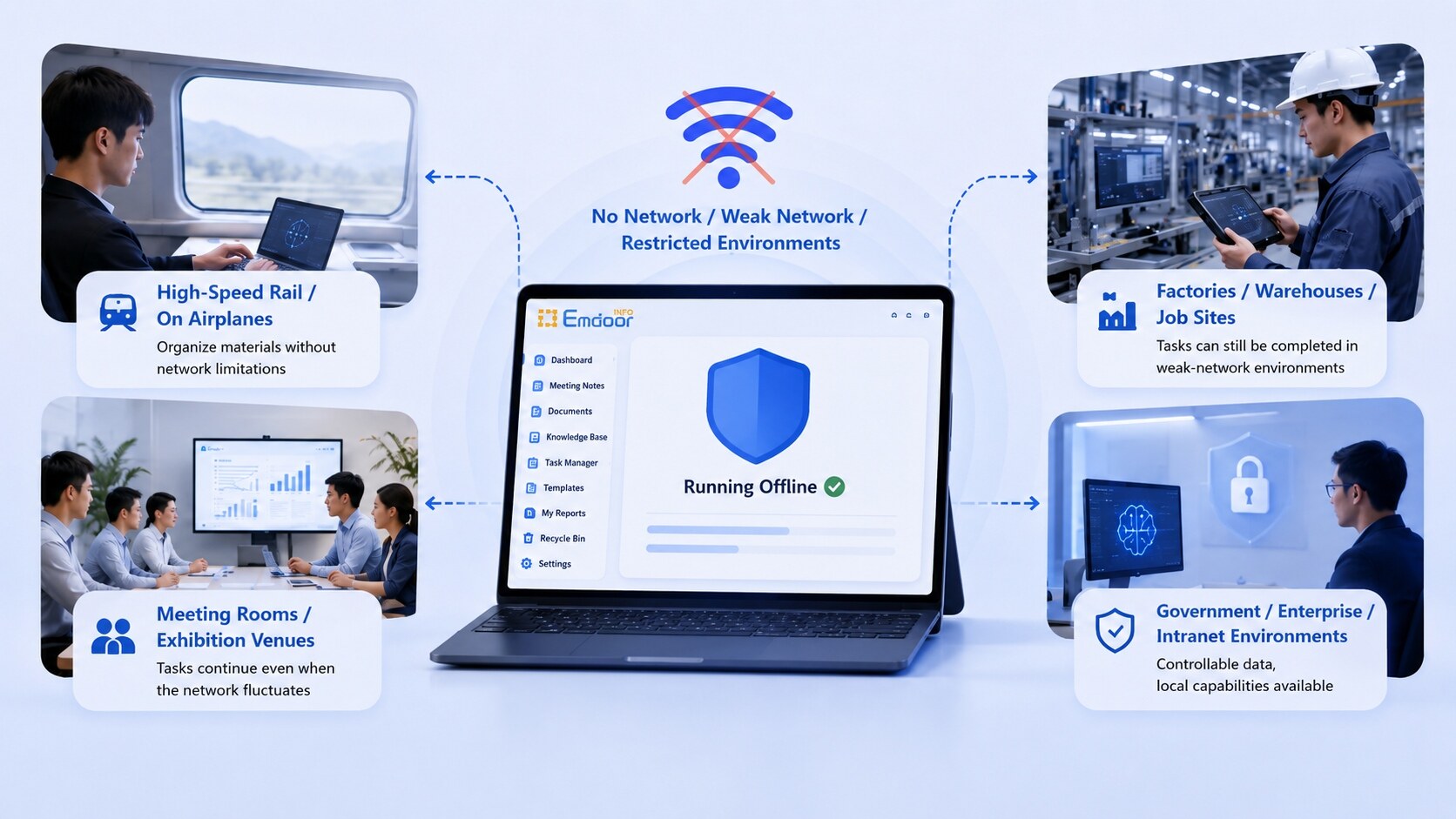
This matters in many real scenarios: unstable connections during business travel, restricted access in office environments, temporary network issues during exhibitions, or limited connectivity during on-site customer visits. If AI depends entirely on the cloud, it may become unavailable at exactly the moment users need it most.
Ailyn addresses this challenge through on-device model capability. High-frequency, basic, and clearly defined tasks do not need to rely on cloud access every time. Even in offline, weak-network, or restricted-network environments, AI can continue to provide essential support.
This is not about making AI do everything offline. It is about ensuring that the most common and necessary tasks remain available when conditions are not ideal.
Offline and Weak-Network Scenarios
- Summarizing documents during business travel.
- Processing internal materials in restricted networks.
- Continuing product demonstrations during exhibitions.
- Completing basic writing, organizing, and task recording when cloud access is unavailable.
Why It Matters
On-device AI is valuable not because it shows the highest possible capability, but because it protects the minimum level of usability in real working environments.
Ailyn does not only focus on the upper limit of AI capability. It also focuses on the lower limit of real-world usability.
When the network is unstable, on-device capability helps keep basic tasks running. When cloud access is available, cloud-side capability can support more complex and large-scale tasks. Through cloud-device collaboration, AI is no longer limited by a single operating environment, giving users a more stable and continuous experience across different scenarios.
Practical view: a truly reliable AI assistant should not only work well under ideal network conditions. It should also remain useful, stable, and available when users face real-world constraints.
02 Experience Retention: Reuse What Already Works
AI Should Not Start from Zero Every Time
For AI to create long-term value, it should not only complete one task. It should also understand how users prefer to complete tasks.
In daily work, many tasks are highly repetitive. Weekly report structures, meeting minute formats, document organization standards, translation tone, summary style, spreadsheet processing rules, code review focus, and output preferences often appear again and again.
These requirements are not always complex, but explaining them repeatedly takes time.
Ailyn’s answer is experience retention.
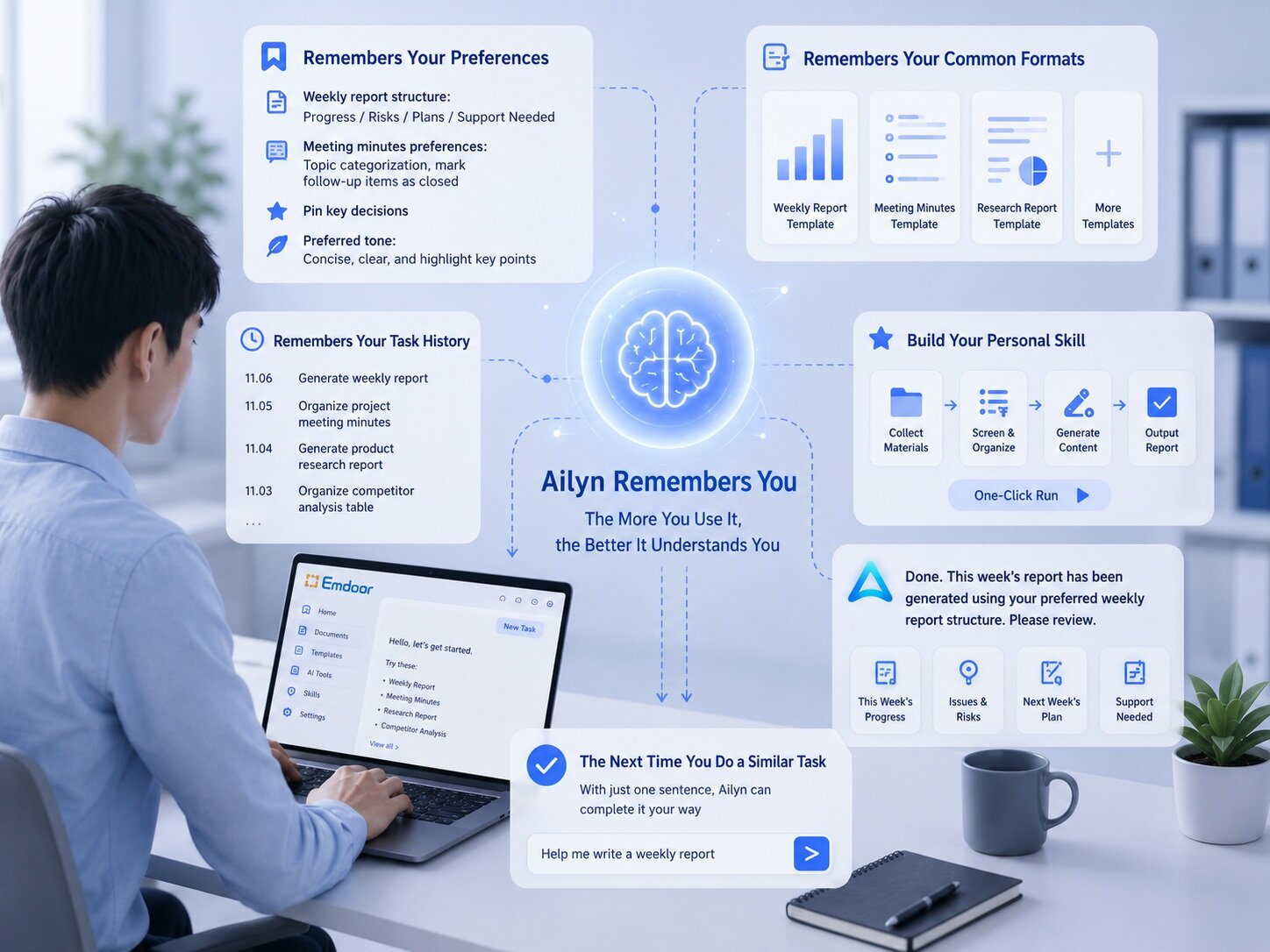
With user authorization, Ailyn can record successful task execution paths, including workflow steps, output rules, formatting preferences, task procedures, and content standards. As users continue to work with Ailyn, these proven methods can gradually become reusable personal Skills.
When a similar request appears later, Ailyn can call the existing method instead of requiring the user to explain everything from the beginning.
Work Scenarios
- Document organization.
- Meeting reports.
- Batch spreadsheet processing.
- Code review.
- File archiving.
Daily and Scheduled Scenarios
- Travel planning.
- Bill archiving.
- Household budgeting.
- Medication reminders.
- Device inspections and periodic summaries.
A simple instruction can trigger an entire workflow that has already been tested and refined.
This means AI is no longer just a tool waiting for prompts. It can gradually become an assistant that understands user habits, preserves personal methods, and helps reuse successful experience.
03 Preference Learning: Output That Fits You Better
Beyond Skills, Ailyn also focuses on learning user preferences.
When generating the same type of content, different users may expect very different results. Some prefer a professional and formal tone, while others prefer a lighter and more approachable style. Some care most about speed, while others care about details, reasoning, and safety boundaries. Some want concise output; others need a more complete structure.
These preferences are difficult to define with a single fixed rule, but they strongly affect the actual AI experience.
Ailyn continuously learns from user behavior, revision patterns, and task feedback, helping its output become closer to the user’s preferred working style over time. As usage continues, AI understanding is no longer limited to a single conversation. It becomes part of a more stable and continuous collaboration.
To support deeper contextual understanding, Ailyn includes memory features and a local knowledge base. Through scheduled screenshots, task trace recording, and local file management, Ailyn can help users review daily work, identify unfinished tasks, and provide richer context for future tasks.
For example, when users want to review the day’s work, Ailyn can help organize completed tasks, pending items, and key records. When users continue an unfinished task from the previous day, Ailyn can understand the background more quickly through local context. When users repeatedly perform similar workflows, Ailyn can help turn those proven methods into reusable capabilities.
The purpose is not to make every decision for the user. The goal is to help AI better understand the methods users have already verified and reuse them at the right time.
04 On-Device First: Secure and Controllable
The more AI understands the user, the more important the safety boundary becomes.
Ailyn follows an on-device-first design approach. Historical records, user memory, task traces, and local files are prioritized for local storage and processing. Users remain in control of what information can be retained, what does not need to be recorded, and what should be modified or deleted.
This is one of the key differences between Ailyn and a one-time question-answering tool.
For AI to become a long-term assistant, it cannot only focus on stronger capability. It must also respect user control over data, privacy, and boundaries. Users can decide what AI should remember, and they can also decide what AI should forget. Users can allow AI to learn working habits, and they can adjust the scope of that learning at any time.
This is your AI. You define its boundaries.
The on-device-first approach not only improves basic availability under weak or offline network conditions, but also provides a safer foundation for personal memory, local knowledge bases, and long-term preference learning. As AI becomes more familiar with the user, security, transparency, and controllability must remain part of the system capability.
05 Offline Continuity and Reusable Experience Build the Foundation for Long-Term AI
Ailyn’s long-term value can be summarized in two sentences:
Offline Availability
Offline availability keeps tasks from being interrupted by network limitations.
Reusable Experience
Reusable experience prevents AI from starting from zero every time.
The first solves the problem of stability. Whether the network is ideal or not, AI should maintain essential capabilities whenever possible.
The second solves the problem of continuity. As users continue to work with AI, it should gradually understand their habits, retain successful methods, and reuse them in future tasks.
Together, these two capabilities form the foundation of Ailyn’s long-term experience.
A truly useful AI assistant should not only perform well in a single conversation. It should not only look powerful in a demo environment. It must face real work, real life, real networks, real tasks, and real user habits.
Ailyn is designed to provide this kind of AI experience: it can continue offering essential support when the network is unstable, retain experience through repeated use, gradually understand user preferences, and become a more reliable and personal AI assistant within secure and controllable boundaries.
Conclusion: Stronger Capability, More Reliable Everyday Use
The value of AI is not only measured by how impressive a single result can be. It is also measured by whether AI can consistently integrate into everyday work and life.
Ailyn does not only pursue stronger model capability. It also places continuity, reusability, personalization, and safety boundaries at the center of the user experience.
Offline availability helps AI maintain basic capability under weak, offline, or restricted network conditions.
Experience retention allows successful methods to be saved, reused, and continuously improved.
Preference learning helps AI become closer to each user’s working style over time.
On-device-first design keeps data and memory within a more controllable environment.
This is the value Emdoor Group aims to deliver through Ailyn: AI that is not only powerful at its upper limit, but also reliable in real-world use, continuously improving, and increasingly aligned with the people who use it.